
What Is Backlight Bleed and Is It Normal?
By BestScreenTester · Published · Updated
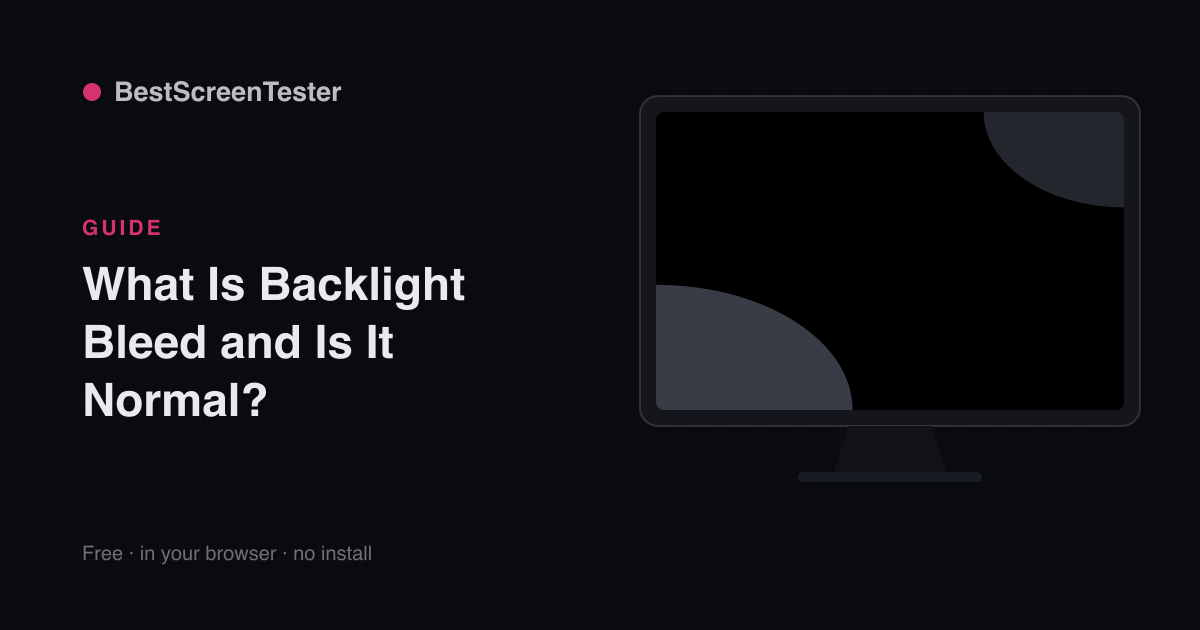
Backlight bleed is light from an LCD's backlight escaping unevenly around the panel edges, visible as cloudy patches on dark content.
See it
In a dark room at full brightness, open the Backlight Bleed Test (a pure black field) and inspect the edges and corners.
Give your eyes two or three minutes to adapt to the dark first — bleed always looks worse in the first thirty seconds. Sit at your normal viewing distance, not with your nose against the bezel, and judge with your eyes rather than through a phone camera. A long-exposure photo brightens everything and routinely makes a perfectly acceptable panel look unusable.
Why it happens
The backlight sits behind or along the edge of the panel and has to be blocked by layers of diffuser, polarizer and liquid crystal. Any gap in that stack lets light out where it shouldn't. Typical causes:
- Assembly pressure — a bezel or frame clamped slightly too tight distorts the layer stack at that point.
- Edge-lit designs — LEDs along one edge push light sideways across the whole panel, so leaks concentrate near that edge.
- Transport and handling — a knock in shipping can shift the stack.
- Heat cycling — layers expand at different rates, which is why bleed sometimes changes slightly over the first weeks.
None of this is something you caused, and it is entirely a panel-lottery outcome: two identical units off the same line can differ considerably.
Is it normal?
Some bleed is normal — LCDs are lit from behind and can't seal perfectly. It becomes a problem when:
- It's bright enough to notice during normal dark-scene viewing (movies, games).
- It's heavily concentrated in one corner.
- It looks like distinct flashlight beams rather than faint, even glow.
A useful practical test: play an actual dark scene at your normal brightness, in your normal room lighting. If you cannot see the bleed under those conditions, it will not bother you. A black test field at maximum brightness in a blacked-out room is a diagnostic, not a viewing condition.
Bleed vs IPS glow vs clouding
- Bleed: visible head-on; doesn't move with your head. A panel/assembly issue.
- IPS glow: a silvery sheen in corners that shifts as you move. Normal for IPS — see our IPS glow guide.
- Clouding (mura): irregular blotches spread across the middle of the panel rather than the edges. Best seen on a dark grey field rather than pure black.
The head-movement check settles bleed versus glow in seconds: lean left and right, then up and down. Glow moves and changes intensity, bleed stays exactly where it is. Backlight bleed vs IPS glow walks through the comparison in more detail, and the Viewing Angle Test makes the angle dependence obvious. For blotchy mid-panel unevenness, the Brightness Uniformity Test is the right pattern.
What you can do
- Lower brightness — bleed scales with backlight intensity. Dropping from 100% to a more typical 30-40% for dark-room use often removes the complaint entirely.
- Add a bias light behind the screen. Raising the ambient level slightly reduces your eyes' sensitivity to faint edge glow, and it is easier on your eyes anyway.
- Gently flex the bezel; sometimes assembly pressure is the cause (do this carefully).
- Check the display isn't being squeezed by a monitor arm clamp, a tight laptop case, or a screen protector pressing on the edges.
- Leave it alone for a couple of weeks before deciding. Mild bleed frequently settles as the panel heat-cycles.
Do not loosen the bezel screws or dismantle the housing. It voids the warranty and rarely helps.
When to return it
If it's severe, it's a valid reason to exchange the unit. Judge it against three questions: does it show during ordinary content, is it in more than one area, and would you notice it if nobody had told you to look?
Timing matters more than argument. Manufacturer warranties often treat mild bleed as within specification, because there is no pixel-style standard for it — but a retailer's return window generally does not require you to prove a defect. Decide within that window. If you exchange, test the replacement the same way immediately, and be prepared for it to be different rather than better.
OLED has no backlight and therefore no bleed. Mini-LED backlights split the light into hundreds or thousands of independently dimmed zones, which suppresses bleed but introduces blooming around bright objects instead — the trade-off is covered in Mini-LED vs OLED.
Run the black field once at your normal brightness before you decide anything — that is the only result that reflects how you will actually use the screen.